”The social structure and the state are continually evolving out of the life-process of definite individuals, but of individuals, not as they may appear in their own or other people’s imagination, but as they really are; i.e. as they operate, produce materially, and hence as they work under definite material limits, presuppositions and conditions independent of their will.” - Karl Marx and Frederick Engels, section on ‘Ideology’, The German Ideology (London : Lawrence and Wishart, 1974), ed. C.J. Arthur, pp. 46-48
I would like to focus this week’s post on the manifestation of Ideology in the media and how certain capitalist ideologies contribute to media obsessed with production and therefore audience consumption. Karl Marx, a very famous 19th-century German philosopher is an excellent example of this cycle of consumption. Marx suggested that those who are in/have power in our society create and establish dominant ideologies and these ideologies are often designed with a heavy focus on economics.
“The concept of ideology as false consciousness was important in Marx’s theory because it appeared to explain why it was that the majority in capitalist societies accepted a social system that disadvantaged them”. - Phillip Rayner, Peter Wall and Stephen Kruger, ‘Ideology and Advertising’, Media studies: the essential resource (London and New York : Routledge, 2004), p.81
To Marx, a socialist regime was almost inevitable for the future. Marx theorised that the workers of a capitalist society would eventually triumph over their capitalist overlords to create a new kind of society. It is clear that Marx very clearly opposed the structures and Ideologies set at the time of the industrial revolution,a period which triggered a gigantic economic growth. However these principles and ideologies can be seen even more clearly today in a society obsessed with production and consumption.
An example of this can be visualised clearly in the gaming industry. Video games are sold at face value for an consistently increasing, already large price and are often untested, unfinished and incomplete. New marketing models have been introduced which promote quick production output and excessive consumption at a high price. Most major game companies heavily root the relatively new feature of downloadable add-on content, known colloquially to gamers as ‘DLC’. Originally these features were designed to add more to the original game and keep keen players occupied and engaged even after the original game had been completed. This almost revolutionary idea which came with the introduction of the internet to gaming consoles, quickly snowballed into a business plan which revolved around the exploitation of players. Games are split up into segments, and sold to the player to maximise profits for the producers.
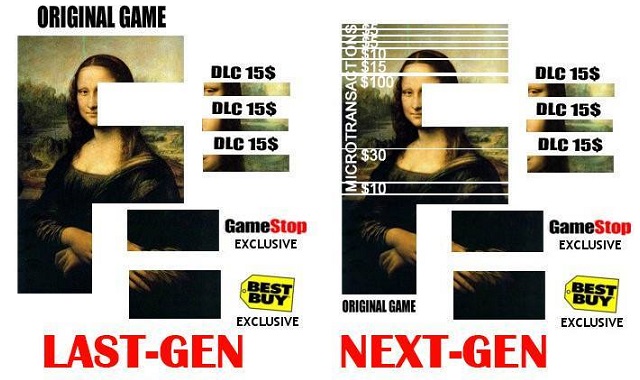
(Image by disqus.com)
This can be seen as a modern example to Marx’s understanding of capitalist ideology. The game companies create and adapt different/new ideologies to continuously exploit players and inevitably, dissatisfy them.

No comments:
Post a Comment